Bigger projects are rarely paid in one go. You might ask for half up front before you start, a second payment at a milestone, and the rest on delivery. Or a client might simply pay what they can now and the balance next month.
None of that is a problem, as long as everyone can see what has been paid and what is still owed. This guide covers the words, two ways to bill a project in parts, how to record each payment, and what a good receipt looks like.
The words, in plain English
- Deposit (or advance): money paid before work starts, often 30% to 50% of the total. It secures your time and covers early costs.
- Part payment (or partial payment): any payment that covers only some of an invoice.
- Installment: one of several planned payments, usually on agreed dates.
- Balance (or balance due): what is still owed after the payments so far.
- Receipt: a document confirming that money has arrived. An invoice asks for money; a receipt confirms it was paid.
Two ways to bill a project paid in parts
Option A: one invoice, several payments
You send one invoice for the full amount. Each time the client pays, you record the payment against that invoice, and the balance goes down until it reaches zero. This is the simplest choice for small and medium projects, and for clients who pay "some now, the rest later" without a formal plan.
Option B: a separate invoice for each stage
You send a deposit invoice first, then a milestone invoice, then a final invoice. Each one is paid in full. This suits larger projects, payments that fall in different tax periods, and clients whose accounts team wants one invoice per payment.
| One invoice, several payments | Separate invoice per stage | |
|---|---|---|
| Best for | Small and medium jobs, informal part payments | Large projects with planned stages |
| Paperwork | One invoice, one receipt per payment | Several invoices, each paid in full |
| Balance | Shown on the invoice as payments come in | Each new invoice carries the next amount |
| Watch out for | Recording every payment with its date | Referencing the project and earlier invoices |
Either way works. Pick one and agree it with the client before the project starts, ideally in the quote.
How to write a deposit invoice
A deposit invoice is a normal invoice with a clear description of what the payment is for. A good line item reads something like:
50% deposit for website redesign, as agreed in quote QUO-0002. Total project price $4,800. Balance of $2,400 due on delivery.
- Reference the quote or agreement, so the client can see where the number came from.
- State the total project price in the line or the notes, so the deposit makes sense on its own.
- Make it due before work starts, for example "due on receipt".
- Say what happens to the balance: when it will be invoiced or when it is due.
If you use DueStamp's quotes, your client can accept the quote online, and you turn it into an invoice in one click. From there you can bill the deposit or the full amount.
How to record a part payment
Every time money arrives, write down four things straight away, while you can still find the bank notification:
- The amount received.
- The date it arrived.
- The method: bank transfer, Payoneer, Wise, PayPal, bKash and so on.
- A reference, such as the transfer ID, if there is one.
In DueStamp, open the invoice and click Record payment. Enter the amount, date and method. The invoice shows what has been paid and the balance, its status changes to Part paid, and you can download a receipt for that payment. When the balance reaches zero, the invoice is marked as paid.
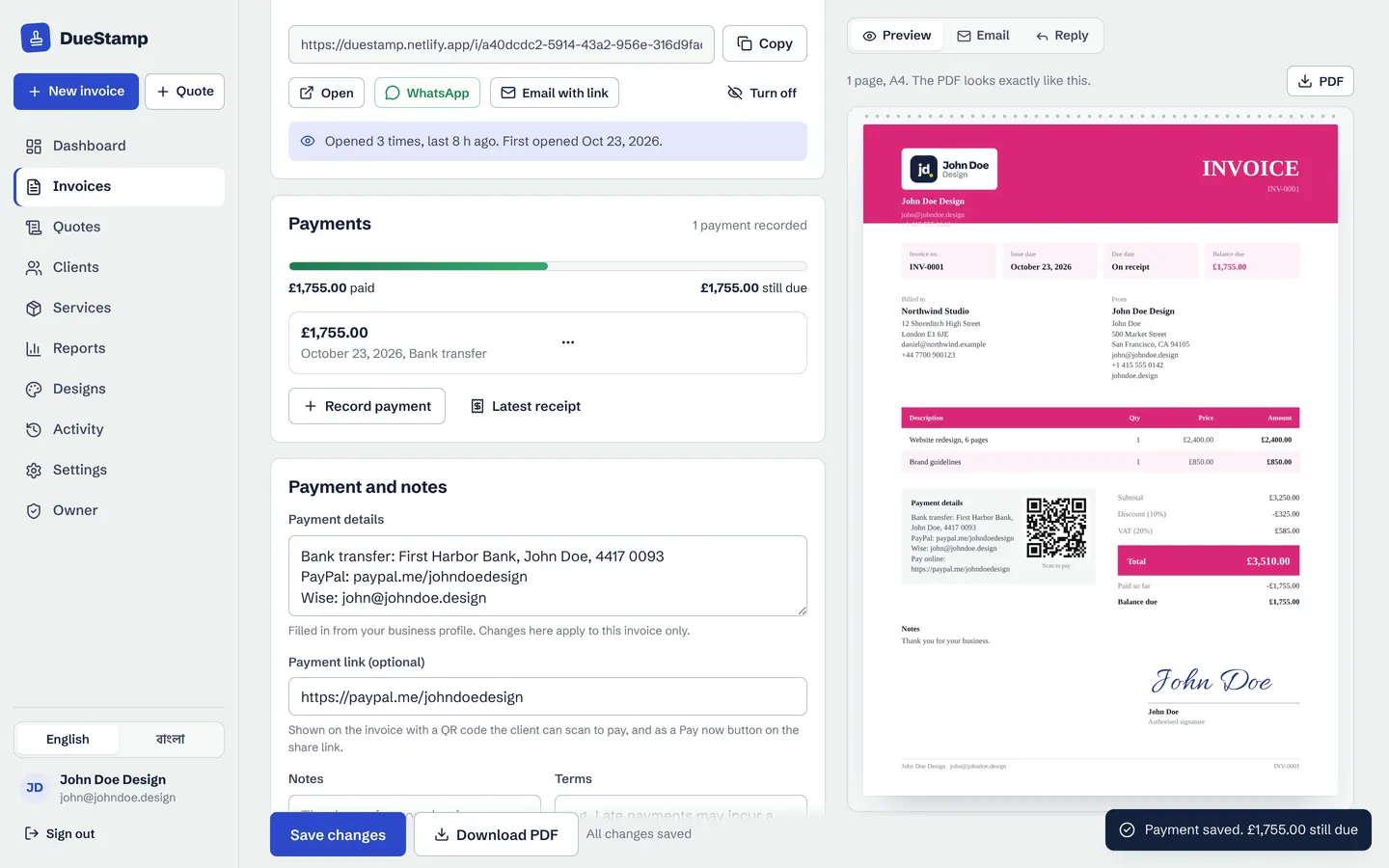
The Payments panel keeps every payment, the running balance and a receipt for each one in one place.
What a payment receipt should include
A receipt should only go out once the money has really arrived, not when the client says it is on its way. A clear receipt includes:
- Your name or business, and the client's name
- The date the payment was received
- The amount paid and the currency
- The payment method and any reference
- The invoice number it relates to
- The balance still due, if any
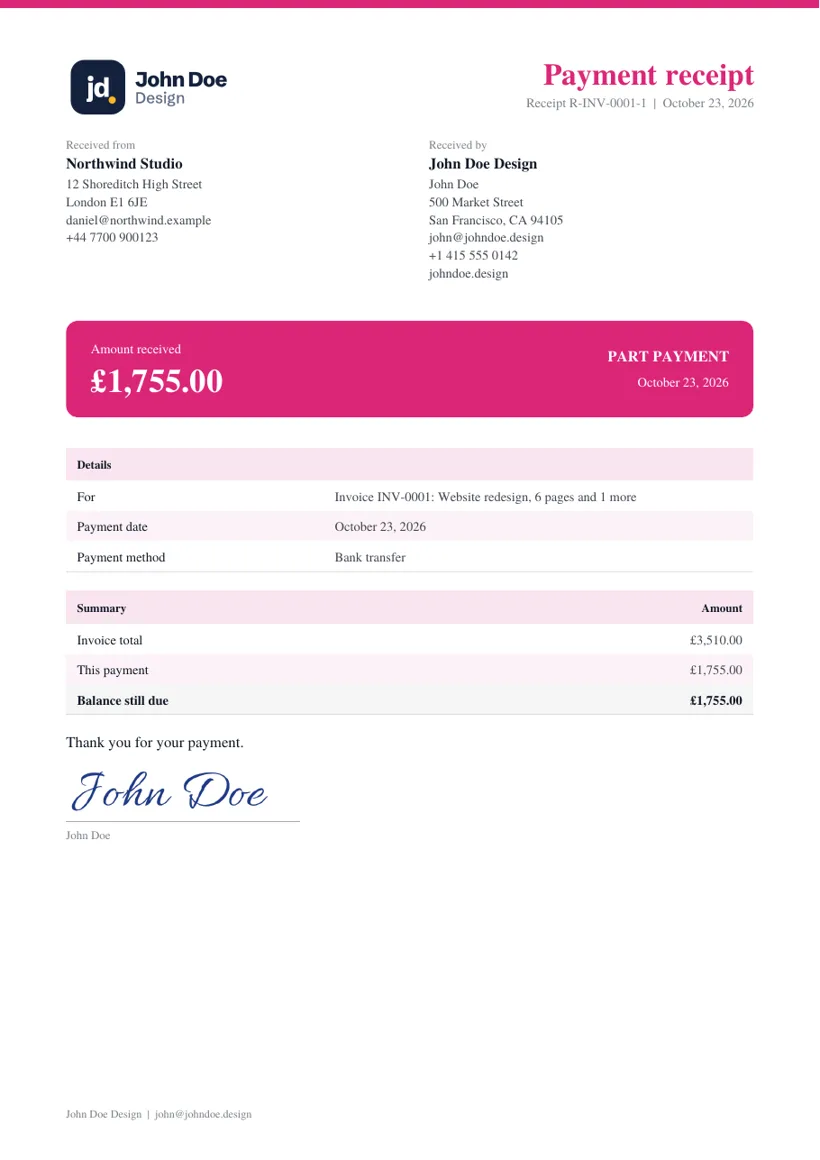
Send the receipt with a short thank-you email. There is a ready-to-copy "part payment received" email in our payment reminder templates.
DueStamp keeps the balance up to date and makes a receipt PDF for every payment. Free, no credit card.
Transfer fees and currency differences
When clients pay from abroad, the number that lands in your account is often a little lower than the invoice, or in a different currency altogether. A client pays $1,000, your provider takes a fee, and what reaches you is converted into your own currency.
Two habits keep this tidy:
- Do not change the invoice amount. If the client sent the full amount and the difference is your provider's fee, the invoice is paid in full. If fees are taken on the client's side, agree who covers them, ideally in your terms.
- Note what actually arrived. DueStamp lets you record what reached your account in your home currency, so your reports show your real earnings after fees.
More on this in our guide to invoicing international clients.
Following up on the balance
A balance is easy to forget, on both sides. Mention it in your thank-you email, with the amount and the date it is due. If the date passes, follow up the same way you would for any overdue invoice. DueStamp's payment reminders include emails for part payments and overdue balances, and the dashboard lists invoices that need chasing.
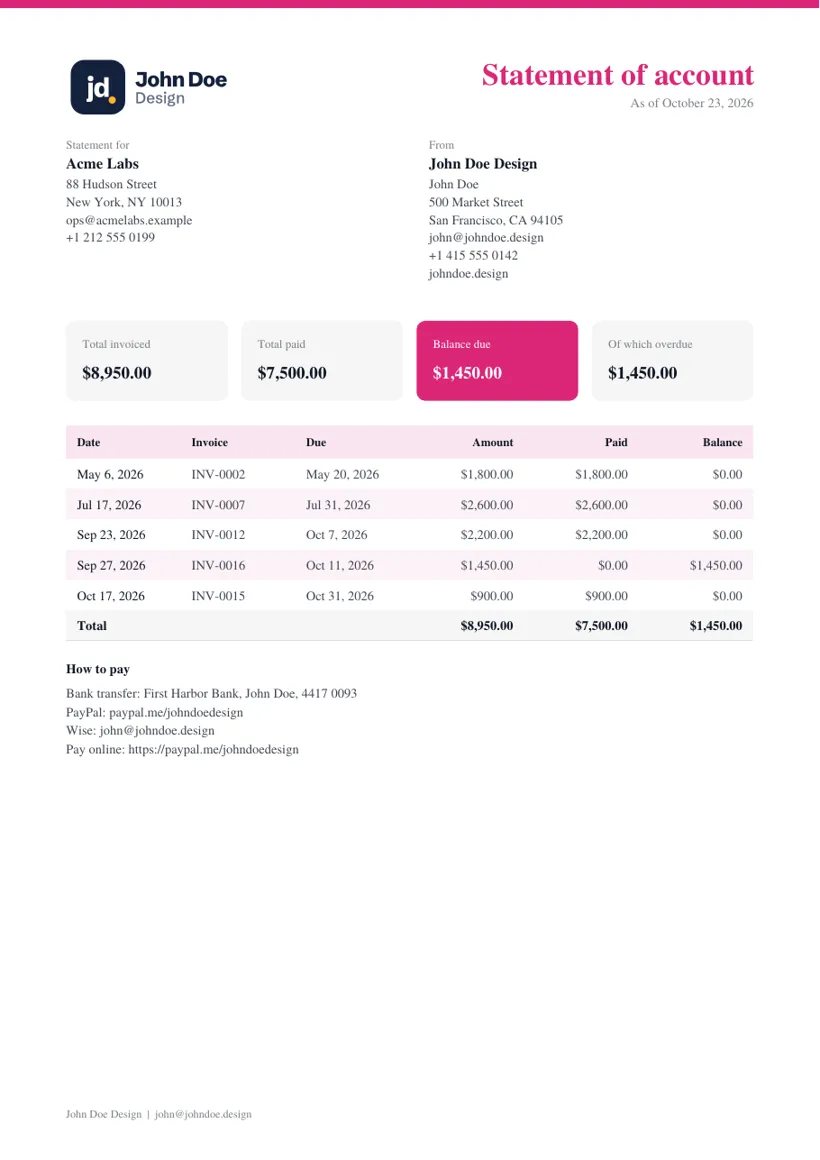
For clients with several invoices and payments over time, a client statement lists every invoice, payment and balance in one PDF. It is the quickest way to agree on exactly what is outstanding.
Common questions
Should a deposit be a separate invoice?
It can be either. A separate deposit invoice is common for large projects and clients with strict accounts teams. For smaller jobs, one invoice for the full amount with the deposit recorded as a part payment is simpler. Agree which one you will use before you start.
Is a receipt the same as an invoice?
No. An invoice asks the client to pay. A receipt confirms that a payment has been received. You send the invoice first, and a receipt after the money arrives.
What does "balance due" mean on an invoice?
It is the amount still owed after any payments already made. If an invoice is for $3,000 and the client paid a $1,000 deposit, the balance due is $2,000.
Can I send a receipt for a part payment?
Yes, and it is a good habit. Each receipt should show the amount received, the date, the invoice it relates to and the balance still due. DueStamp makes a receipt PDF for every payment you record.
How do I show a partial payment on an invoice?
List the total, then the amount paid so far, then the balance due. In DueStamp, recording a payment updates the paid amount and the balance for you and marks the invoice as Part paid.

Rafiul made DueStamp, a free invoice maker for freelancers and business owners. He writes these guides to answer the questions people ask while sending their first invoices. More about DueStamp.